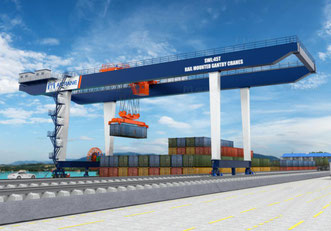
Rail-Mounted Gantry (RMG) cranes are among the most sophisticated and efficient lifting equipment in container terminals, especially for the task of handling high-stack containers. These cranes are designed to lift and move containers that are stacked several levels high, making them invaluable for port operations, logistics, and supply chain management. As container traffic increases and ships grow in size, RMG cranes have evolved to meet the demands of handling large volumes of containers safely and efficiently. This article will delve into how RMG cranes handle high-stack container lifting, examining the technological advancements, operational principles, and safety features involved in this complex task.
What are RMG Cranes?
Rail-Mounted Gantry cranes are large, heavy-duty cranes used primarily in container ports to handle the loading and unloading of containers from trains, trucks, and ships. The distinguishing feature of a rail mounted gantry crane is its ability to operate on rails, allowing them to cover large distances along the container yard. Their high lifting capacities and ability to work with containers stacked multiple levels high make them an essential piece of equipment in modern container terminals.
RMG cranes are typically used for land-based container handling, particularly in areas where containers are stacked several levels high. They are capable of lifting containers from the ground level to the top of a stack, or vice versa, and can move containers horizontally along their rails to position them as required.
Challenges of High-Stack Container Lifting
Lifting high-stack containers presents several challenges, including:
-
Weight Distribution: Containers stacked several levels high can have uneven weight distribution, creating imbalances that could cause safety issues if not handled properly.
-
Height Considerations: The higher the stack, the more difficult it becomes to reach the container’s top, especially as containers can be stacked up to 12 or more levels high in some terminals.
-
Precision Handling: High-stack container lifting requires great precision to avoid misplacement, damaging containers, or interfering with neighboring stacks.
-
Wind and Environmental Factors: Lifting high stacks can expose cranes to wind conditions, which can be more challenging at greater heights. The crane needs to operate efficiently in varying environmental conditions.
-
Efficiency and Speed: Container terminals operate under strict time constraints, and lifting high-stack containers quickly and safely while maintaining precision is crucial to keeping operations running smoothly.
The Role of RMG Cranes in High-Stack Container Lifting
RMG cranes are equipped with several features that make them capable of handling high-stack containers with ease. Below are some of the most important factors that enable RMG cranes to perform this complex task.
1. Design Features for High Reach and Stability
RMG cranes are built to reach the top of high stacks of containers, often as high as 12 to 15 meters or more. The RMG container cranes are equipped with tall masts and robust structural frames designed to withstand the stresses associated with high lifting. The trolley mechanism, which is responsible for moving the hook vertically, is designed to provide precise lifting capabilities. Additionally, the spreader bar at the end of the lifting rope ensures that containers are lifted evenly, preventing tilting or unbalanced lifting.
2. High Lifting Capacity
High-stack container lifting requires cranes with significant lifting capacities. RMG cranes are typically equipped with lifting capacities ranging from 30 tons to over 100 tons, allowing them to lift multiple containers stacked on top of one another without strain. The lifting mechanism is powered by electric hoists or hydraulic systems, depending on the specific requirements of the terminal. These systems are designed to provide consistent, reliable performance even under heavy loads.
Advanced Control Systems
RMG cranes use advanced control systems to manage the movement of containers at height. These systems include load monitoring, anti-sway technology, and precise control of lifting speed. The cranes are often equipped with sensors that detect the position of the container and adjust the movement in real-time to prevent sway, a common issue when lifting containers at height. Anti-sway technology ensures that containers remain stable during the lifting process, reducing the risk of accidents or damage.
Integrated Safety Features
Safety is a primary concern when handling high-stack containers. RMG cranes are equipped with a variety of safety features to ensure that lifting operations are carried out without incident. Some of the key safety features include:
-
Anti-Sway Mechanisms: Anti-sway systems work by adjusting the crane’s movements to counteract the natural swinging motion that can occur when lifting containers at height. These systems ensure that the container remains steady during the lift, preventing accidents and ensuring that containers are placed precisely.
-
Overload Protection: RMG cranes are equipped with overload protection systems that prevent the crane from lifting more than its rated capacity. This is particularly important when dealing with high-stack containers, as an overloaded crane could result in structural failure or other safety issues.
-
Wind Speed Sensors: Given that high stacks of containers are more susceptible to wind forces, modern RMG cranes are equipped with wind speed sensors. These sensors monitor wind conditions and automatically reduce the lifting speed or suspend lifting operations if wind speeds exceed safe limits.
-
Redundant Systems: Many RMG cranes have redundant systems, such as backup power supplies and dual control circuits, to ensure that the crane remains operational even in the event of a failure in one of the primary systems.
Precision Hoisting and Horizontal Movement
When lifting containers from high stacks, precision is paramount. RMG cranes use sophisticated hoisting systems that allow for smooth and controlled vertical movements. The hoist system includes a combination of pulleys, motors, and sensors that allow for micro-adjustments in the container’s positioning. This level of control is crucial when lifting high-stack containers, as any slight misalignment could result in a misplacement or damage to the container.
Additionally, RMG cranes can move horizontally along their tracks to reposition containers. This horizontal movement is controlled with precision to ensure that containers are placed exactly where they are needed, even when working with containers that are stacked at extreme heights.
Operational Efficiency
RMG cranes are designed for fast, efficient operations, with minimal downtime. They are equipped with powerful drive systems that allow them to quickly move along the rail tracks and lift containers at high speeds. However, despite their speed, RMG cranes are also designed to operate smoothly to prevent jerky movements that could cause containers to swing or become misaligned.
The efficiency of RMG cranes is further enhanced by automated systems that assist with loading and unloading operations. These systems optimize the lifting process by calculating the best path for the crane to take, reducing the time spent on each lifting cycle.
Conclusion
RMG cranes play a crucial role in modern container handling operations, especially in environments where containers are stacked high. Their ability to safely and efficiently handle high-stack container lifting is facilitated by their advanced design, high lifting capacities, precision control systems, and integrated safety features. As container terminals continue to grow and evolve, RMG cranes will remain an indispensable tool for meeting the demands of high-volume, high-stakes container handling operations. With ongoing advancements in technology, we can expect RMG cranes to become even more efficient, safer, and capable of handling even the most challenging container lifting tasks.